Clear, physics-based explanations to help you understand surge, earthing and lightning protection — so you can make informed decisions.
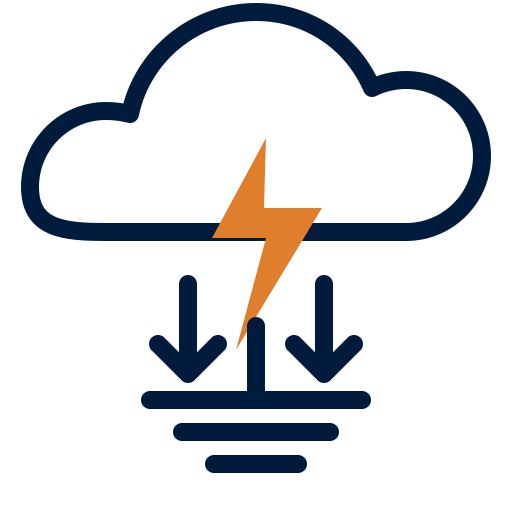
A lightning protection system disperses lightning energy into the ground
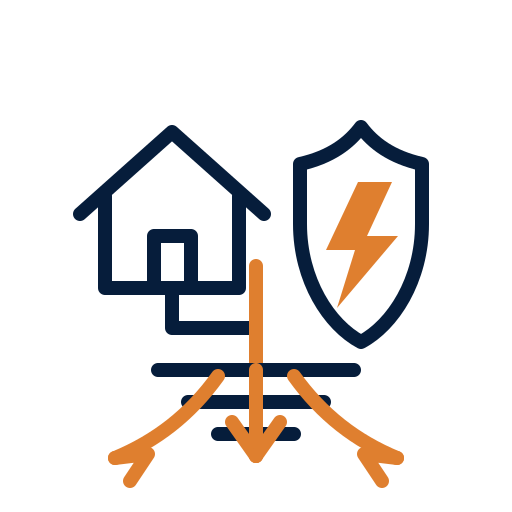
Lower resistance allows energy to safely dissipate into the ground.

Yes — both are required.

Learn why installed ≠ effective.
Get a professional site assessment and know where you stand.
Get a Site Assessment Talk to an Expert
Lightning is a high-energy electrical discharge caused by charge buildup between clouds and the ground or within clouds.


Lightning carries massive energy that must be safely controlled. If not, it will pass through structures, systems, or equipment.

Lightning cannot be prevented — only safely intercepted, conducted, and dissipated.
A lightning protection system manages energy in three steps through proper lightning arrester installation:
A system is only effective if the entire path is properly designed. Installing a lightning rod alone does not protect a building.
Yes — but all effective systems follow the same engineering principles.
The effectiveness depends on design and execution — not the label or type.
The correct system depends on the building’s size, height, usage, and environment.
There is no “one-size-fits-all” solution.
Proper protection is engineered — not selected from a catalog.
Not necessarily.
A lightning rod installation protects against direct lightning strikes, but complete safety also requires proper earthing, bonding, and surge protection.
A lightning rod alone equals safety — it does not.
Not all buildings require it, but many do in a lightning-prone area.
A professional lightning risk assessment determines whether a building needs protection. It helps identify if a lightning arrester for a house or a suitable lightning protection system for commercial, industrial, or public buildings is required to reduce lightning-related risks. The risk assessment also takes into account the previous incidences of lightning in the geographical area.
It is a safety guideline to estimate lightning proximity and risk.
It helps reduce personal risk during storms.
This is a safety rule — not a protection system.
Performance is confirmed through regular testing, not by assuming the installed components are working.
A system can look intact on the surface while its actual protection value has degraded over years of exposure.
A lightning protection system is only as reliable as its last inspection, not its installation date.
Same principle, different scale! Bigger structures need higher capacity, multiple points, and stronger earthing.
What actually happens
Using an undersized system on a large structure leaves gaps in protection, and oversizing for a home adds unnecessary cost.
A lightning arrester for building structures is engineered differently to match its size and risk level.
Quick, clear response
Understand the science
Know the real impact

What most people get wrong
 No measurement No verification Fragmented design
Engineering makes
the difference.
Earthing provides a safe path for electrical fault currents and lightning energy to flow into the ground.
Without proper earthing, protection systems cannot function effectively because they all depend on a safe, low-resistance path to earth to discharge dangerous electrical energy.
Lower resistance allows energy to safely dissipate into the ground.
A lightning strike can carry extremely high current — often tens of thousands of amperes. The lightning protection system captures this energy through air terminals and down conductors, but the current must finally be dispersed safely into the soil through the earthing system.
SPDs do not “stop” surges; they divert excess voltage safely to earth.
During insulation failure or short circuits, fault current must flow rapidly to earth so that circuit breakers trip, fuses operate, and protective relays detect the fault.
Earthing establishes a common reference potential for the electrical system.
A protection system without proper earthing is like a drainage system without an adequate outer pipe: the water or electrical energy is collected, but it has nowhere safe to go.
Earthing is not just about connection — it is about performance.
It depends on the application, but lower values are generally better.
There is no universal earth resistance value. The required resistance depends on the system type, site conditions, risk level, and the performance of the earthing rod, plate or strip and the overall earthing system. The system should always be designed and tested according to applicable standards and project requirements.
Most failures are due to poor design, installation, or lack of maintenance.
Regular inspection of the earthing chamber helps identify corrosion, loose connections, and other issues before they affect the performance and safety of the earthing system.
Earthing must be tested — not assumed.
Because earthing performance cannot be assumed.
Many systems appear functional but fail under real conditions. If it is not measured, it is not known.
Earthing dissipates lightning’s electric charge into the ground — without it, the whole system fails.
Even a well-placed rod is useless if the current has nowhere safe to go. Poor earthing can send current back into the building instead.
Proper earthing and lightning protection go hand in hand — one fails without the other.
An earthing chamber should be checked at least once a year, and always after a major storm or suspected strike.
Earthing performance can quietly degrade due to soil conditions, corrosion, or physical disturbance without inspection, this goes unnoticed until failure.
An earthing chamber isn't a one-time installation; it requires ongoing monitoring to remain reliable.
Surge protection prevents high voltage spikes from entering the circuit.
Modern buildings rely heavily on electronics that are highly sensitive to surges.
SPDs can be grouped under three categories.
Yes — both are required.
Lightning energy can still enter through power lines and internal circuits.
External and internal protection must work together.
An MCB protects the SPD from overload or failure conditions.
Without proper protection, an SPD can become a risk instead of a solution.
Yes — all grounding systems should be properly bonded.
Separate earthing systems can create more risk, not less.
Equipotential bonding is critical for safety.
AIR TERMINAL
   │
Lightning Current
   │
Down Conductor
   │
┌─────────────────────┐
│ Main Earth Bar (MEB) │
└─────────────────────┘
   │     │     │
   │     │     └──────── SPD Earth Connection
   │     └────────────── Electrical System Earth
   └──────────────────── Lightning Earth Electrodes
                         │
                 Ring Earth / Earth Grid
                         │
              Multiple Bonded Earth Pits
Protection must be layered and designed. A single device cannot provide full protection.
A lightning rod intercepts the strike; a lightning surge arrester protects equipment from the resulting surge.
A rod alone protects the building, not the electronics inside it. You need both working together — one to catch the strike, one to stop the surge.
Lightning conductors protect the structure, while arresters protect what's inside it.
Not necessarily.
Partial protection creates a false sense of safety.
Because most systems are installed — not engineered.
Failures are often hidden until a real event occurs.
Installed ≠ Effective.
Because protection performance cannot be assumed — it must be proven.
Without verification, there is no certainty of protection.
Engineering requires measurement — not guesswork.
Yes — electrical protection only works as a complete system.
Failure in one part compromises the entire system.
A system is only as strong as its weakest connection.
Lightning protection engineering is based on the challenge of predicting and controlling one of nature’s most complex electrical phenomena.
Over the years, different lightning protection methodologies have been developed to reduce the probability of direct strikes to structures and safely conduct lightning current into the ground.
Two broad approaches are commonly discussed:
The discussion surrounding these approaches often focuses on one important question:
How is the claimed protection zone determined, and how scientifically validated is the method?
Understanding this question requires examining the engineering principles behind both systems.
No It is important to recognize that no lightning protection system can guarantee absolute prevention of lightning damage under all conditions.
Lightning behavior is influenced by:
As a result, lightning protection engineering is fundamentally based on:
Modern standards therefore rely on:
Conventional lightning protection systems are typically designed according to standards such as IEC 62305 and NFPA 780.
These systems use:
The objective is to intercept lightning and conduct its current safely to earth.
One of the most widely used design methods is the Rolling Sphere Method
The principle is based on the electro-geometric model of lightning attachment.
In simplified terms:
The method imagines a sphere of specified radius “rolling” over the structure.
Any point touched by the sphere is considered vulnerable to lightning attachment and therefore requires protection.
Areas not touched by the sphere are considered protected.
The rolling sphere concept was developed from studies of lightning attachment behavior and transmission line protection models and later incorporated into major standards such as NFPA 780 and IEC 62305.
The radius used depends on the selected Lightning Protection Level (LPL):
Smaller radii correspond to more stringent protection levels.
The rolling sphere method is not merely geometrical; it is derived from electro-geometric attachment models developed from:
However, like all engineering models, it is still a simplification of natural lightning behavior.
Its strengths include:
Its limitations include:
Despite these limitations, the rolling sphere method remains one of the most widely accepted engineering methodologies for lightning protection design worldwide.
ESE systems are based on a different concept.
Manufacturers of ESE terminals claim that their devices generate an upward streamer earlier than a conventional air terminal.
This “streamer advance time” is claimed to increase the interception capability of the terminal and enlarge the protected area.
Based on this principle, ESE systems often claim:
The protection radius is typically calculated using equations defined in specific ESE standards such as NFC 17-102.
The scientific discussion surrounding ESE systems focuses primarily on the question:
Can a terminal consistently and predictably initiate an earlier upward streamer under real atmospheric conditions sufficient to produce the claimed increase in protection radius?
This question remains debated within the lightning protection community.
Some experimental studies and laboratory tests have reported improved interception performance under specific controlled conditions.
At the same time, several scientific and standards organizations have stated that the overall field validation and theoretical basis for large claimed protection radii remain uncertain or insufficiently established.
A review [1] published by the U.S. National Institute of Standards and Technology (NIST) noted that while ESE technologies may hold promise, the scientific basis for significantly extended protection performance remained open to question and required further validation.
“The scientific and technical basis for this improved performance is far from certain and the efficacy of these technologies remains open to question,” the review noted.
NIST publications noted that “the scientific basis and field validation of extended protection claims for ESE systems remained an open technical question requiring further study.”
As a result:
An important engineering principle is that all lightning protection methodologies should ideally be evaluated through:
However, lightning presents unique challenges:
Therefore, all lightning protection approaches involve some level of modeling and engineering approximation.
The real-world performance of any protection system also depends heavily on:
The effectiveness of a lightning protection system should not be judged solely by the claimed coverage radius of the air terminal.
A complete protection system includes:
Even the most sophisticated air terminal cannot provide reliable protection if the overall system design is inadequate.
At OHMdaddy, we believe that lightning protection should be approached as a complete engineering system rather than a single product selection.
Our focus is on:
We encourage customers to evaluate lightning protection systems based not only on claimed coverage radius, but also on:
[1] Van Brunt, R. J., Nelson, T. L., & Stricklett, K. L. (2000) Early Streamer Emission Lightning Protection Systems: An Overview Published in IEEE Electrical Insulation Magazine, Vol. 16, No. 1.
Full coverage is a probability event because the intensity of lightning varies over a wide range. What we can assert with high confidence is that a system designed to fully protect against the heaviest lightning event would cover the area.
A single device has a lower probability of protecting beyond its calculated zone.
Assumed coverage often leads to unprotected areas
Short rods around 1 foot installed on solar panels are insufficient.
This can increase risk to both the solar system and the building. A proper system requires design, not just installation.
Because they handle different parts of the same problem.
If one fails, the entire system is compromised. Effective protection requires a complete, integrated system.
The only reliable way is through measurement.
Visual inspection is not enough. Performance must be measured and confirmed.
Let us evaluate your system using measurement and engineering - not assumptions.